Hair thinning, excessive hair fall, fine lines, uneven skin texture, and loss of facial freshness are common concerns that can affect both appearance and confidence. For people looking for a minimally invasive treatment that uses their own blood rather than synthetic fillers or surgical procedures, Platelet-Rich Plasma (PRP) therapy has become an increasingly popular option.
PRP can be used for different aesthetic purposes, including hair restoration and facial rejuvenation. At Health360, PRP treatments are offered as part of a medically supervised approach to hair and aesthetic care, with treatment plans based on the patient’s individual concerns and goals.
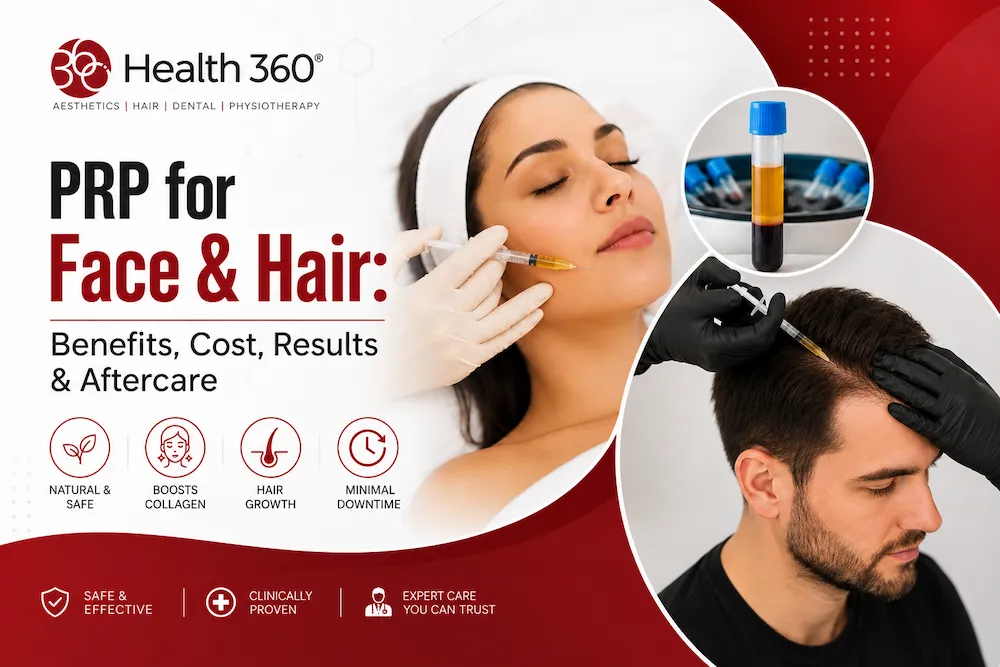
For hair, PRP is primarily used to support weakened follicles, improve hair thickness, and encourage growth in suitable patients with thinning hair. For the face, PRP is used as a regenerative aesthetic treatment intended to support skin quality, collagen-related processes, texture, and overall rejuvenation.
Research suggests PRP can improve some measures of hair density in androgenetic alopecia, while evidence for facial rejuvenation shows potential benefits but also considerable variation between studies.
This guide explains what PRP for the face and hair involves, how the treatment works, who may benefit, what results to expect, how many sessions may be needed, possible side effects, aftercare, and what can influence PRP treatment cost in Pakistan and Faisalabad.
What Is PRP Treatment in Pakistan?
PRP stands for Platelet-Rich Plasma. It is prepared from a small sample of the patient’s own blood. The blood is processed to concentrate platelets and plasma, which contain a range of growth factors and signaling proteins involved in tissue repair and healing.
Once prepared, the concentrated plasma is applied or injected into the treatment area depending on the purpose of the procedure. For hair restoration, PRP is injected into areas of scalp thinning. For facial rejuvenation, PRP may be injected into selected areas of the face or used as part of a skin-focused treatment protocol.
The key attraction of PRP is that it uses the patient’s own blood rather than introducing a synthetic substance into the body. However, using your own blood does not mean that PRP is automatically suitable for everyone. A proper medical assessment is still important before treatment.
At Health360, the PRP hair treatment process involves blood collection, centrifugation, preparation of the concentrated PRP, and targeted injection into areas affected by hair thinning.
How Does PRP Work for Hair?
Hair PRP is primarily used for patients with thinning or weakened hair follicles that may still have the capacity to produce hair. The treatment begins with a small blood sample, usually collected from the arm. The sample is placed into a centrifuge, which separates its components and concentrates the platelet-rich plasma. The prepared PRP is then injected into selected areas of the scalp.
The goal is to expose the targeted scalp areas to concentrated platelets and their associated growth factors. These may support the follicular environment and encourage healthier hair growth.
Research into PRP for androgenetic alopecia (AGA) has become increasingly extensive. A 2024 systematic review and meta-analysis of randomized clinical trials found evidence that autologous PRP can increase hair density in patients with androgenetic alopecia. Other systematic reviews have also reported potential benefits, although differences in PRP preparation, treatment protocols, number of sessions, and study quality mean that outcomes can vary.
This is why PRP should not be presented as a guaranteed cure for hair loss. It is better understood as a treatment that may support hair growth and improve density in appropriately selected patients.
How Does PRP Work for the Face?
PRP facial treatment uses the same basic principle of preparing platelet-rich plasma from the patient’s own blood, but the treatment objective is different.
Instead of targeting hair follicles, facial PRP is used to support skin rejuvenation. The treatment may be considered for people concerned about fine lines, skin texture, elasticity, or an overall tired-looking complexion.
PRP is sometimes referred to as a “vampire facial” in aesthetic marketing, although the exact technique can vary between providers. The important distinction is that PRP is a medical aesthetic treatment and should be performed using appropriate clinical protocols rather than treated as an ordinary cosmetic facial.
Current evidence suggests that PRP and related platelet preparations may improve certain aspects of facial rejuvenation, particularly skin thickness and elasticity. However, the evidence is not equally strong for every outcome, and researchers continue to highlight differences in treatment protocols and study quality.
PRP Face vs PRP Hair: What Is the Difference?
Although both treatments use platelet-rich plasma prepared from the patient’s own blood, their goals and application areas are different.
Feature |
PRP for Hair |
PRP for Face |
| Main Goal | Support hair growth and follicle health | Improve skin quality and rejuvenation |
| Treatment Area | Scalp | Face and selected skin areas |
| Common Concerns | Hair thinning, weak follicles, pattern hair loss | Fine lines, texture, elasticity and skin quality |
| Blood Source | Patient’s own blood | Patient’s own blood |
| Preparation | Blood processed to concentrate platelets | Blood processed to concentrate platelets |
| Application | Targeted scalp injections | Facial application or targeted injections |
| Downtime | Usually minimal | Usually minimal, depending on technique |
| Results | Develop gradually over multiple months | Develop gradually as skin responds |
The right treatment depends on the concern being addressed. Some patients may be interested in both hair and facial rejuvenation, but each area should be assessed separately rather than assuming that the same treatment plan will work for everyone.
Benefits of PRP Hair Treatment in Pakistan
PRP hair treatment is a minimally invasive option for people experiencing hair thinning who want to support existing hair follicles without undergoing a hair transplant. At Health360, it may be recommended for suitable patients with different types of hair thinning and hair loss.
Key benefits include:
- Supports Hair Growth: PRP may stimulate weakened hair follicles and encourage healthier hair growth.
- Improves Hair Density: It can help improve the appearance of thinning hair in suitable patients.
- Reduces Visible Thinning: Strengthening existing follicles may make the hair appear fuller over time.
- Non-Surgical: PRP does not require follicle extraction, scalp incisions, or hair transplantation.
- Uses Your Own Blood: The treatment uses platelet-rich plasma prepared from the patient’s own blood.
- Suitable for Men and Women: PRP may be considered for male pattern baldness, female hair thinning, early-stage hair loss, receding hairlines, postpartum hair loss, and weak or damaged hair.
- Can Complement Hair Restoration: PRP may be used independently or as part of a broader hair restoration plan.
PRP is generally more relevant when viable hair follicles are still present. It cannot recreate follicles that have been permanently destroyed, so patients with advanced baldness may require another approach, such as a hair transplant, depending on their individual assessment.
Benefits of PRP Facial Treatment in Pakistan
PRP facial treatment focuses on improving skin quality and rejuvenation rather than adding facial volume like traditional dermal fillers. It may appeal to people who want a minimally invasive approach to improving the overall appearance and texture of their skin.
Potential benefits include:
- Improved Skin Texture: PRP may help create smoother-looking skin.
- Supports Skin Elasticity: Research has reported potential improvements in skin elasticity following PRP-based treatments.
- Helps Improve Fine Lines: PRP may reduce the appearance of certain fine lines over time.
- Supports Skin Thickness: Clinical research has reported improvements in skin thickness in some patients.
- Natural-Looking Rejuvenation: The treatment uses the patient’s own platelet-rich plasma rather than adding synthetic facial volume.
- Minimal Downtime: PRP facial treatment is a non-surgical aesthetic procedure and generally involves limited recovery compared with surgical treatments.
However, PRP facial treatment should be approached with realistic expectations. It is intended to support skin quality and rejuvenation, not completely eliminate wrinkles, replace significant lost facial volume, or produce the same results as a surgical facelift. Research has shown promising results for some outcomes, but evidence remains variable and individual results can differ.
Who Is a Good Candidate for PRP Hair Treatment in Pakistan?
PRP may be suitable for men and women experiencing certain forms of hair thinning, particularly when viable but weakened follicles remain. At Health360, the service information identifies several common situations where hair PRP may be considered:
- Male pattern baldness
- Female hair thinning
- Early-stage hair loss
- Receding hairline
- Postpartum hair loss
- Weak or damaged hair
A consultation remains important because hair loss can have many different causes. Genetic pattern hair loss, nutritional deficiencies, hormonal conditions, scalp disorders, medications, stress, and other medical conditions may require different approaches.
A patient should not assume that PRP is the correct treatment simply because they are experiencing hair fall. Identifying the underlying problem is an important part of choosing an appropriate treatment.
Who May Benefit from PRP for the Face?
PRP facial treatment may be considered by adults who want to improve skin quality without undergoing a surgical procedure. It may be particularly relevant for people concerned about fine lines, texture, elasticity, or an overall dull appearance. However, suitability depends on individual skin condition, medical history, medications, and treatment goals. A professional assessment is important before proceeding.
PRP should also be distinguished from treatments designed primarily to add volume. If the main concern is significant facial volume loss or deep structural changes, another treatment may be more appropriate.
What Happens During PRP Treatment?
The PRP process is relatively straightforward, but the exact protocol can vary depending on whether the treatment is being performed for hair or facial rejuvenation.
Step 1: Consultation
The treatment begins with an assessment of the patient’s concern. For hair PRP, this includes evaluating the pattern and extent of hair loss. For facial PRP, the practitioner assesses skin quality and the specific areas the patient wants to improve. This stage is important because PRP is not equally effective for every condition.
Step 2: Blood Collection
A small amount of blood is drawn, usually from the patient’s arm. Because the treatment uses the patient’s own blood, the blood collection process is similar to a routine blood draw.
Step 3: Centrifugation
The blood sample is placed into a centrifuge. Spinning separates the blood components and allows the platelet-rich plasma to be collected. The quality and concentration of the prepared PRP can depend on the equipment, preparation method, and clinical protocol used.
Step 4: PRP Preparation
The platelet-rich plasma is prepared for application or injection. For hair treatment, the prepared PRP is targeted toward areas of scalp thinning. For facial treatment, the practitioner determines the appropriate application method according to the treatment plan.
Step 5: Treatment
For hair restoration, PRP is injected into selected areas of the scalp. For facial rejuvenation, PRP may be applied or injected into targeted facial areas depending on the technique being used. The goal is to deliver the platelet-rich preparation to the areas where it is intended to support tissue or follicular activity.
Step 6: Aftercare
After treatment, patients receive guidance on caring for the treated area and any temporary restrictions that may apply.
Our hair PRP service at Health360 describes the procedure as quick, with patients generally able to return to their normal routine the same day.
How Long Does a PRP Session Take?
PRP is generally a relatively quick outpatient treatment. The actual duration depends on the treatment area, preparation method, and whether additional procedures are being performed during the same appointment.
For hair PRP, the process includes consultation, blood collection, centrifugation, preparation, and scalp injections. Because there is no surgical incision or transplant procedure, patients can generally return home after treatment.
PRP procedure at Health360 is fairly quick and our clinical experts ensure that patients can return to their normal routine on the same day.
How Many PRP Sessions Are Needed?
There is no universal number of PRP sessions that works for everyone. Hair PRP is commonly performed as a series rather than as a single treatment. The number and spacing of sessions depend on the patient’s hair loss, response to treatment, treatment protocol, and clinical goals. Our qualified experts at Health360 note that patients often require multiple sessions for optimal results, with sessions typically spaced several weeks apart.
For facial PRP, the number of sessions also varies according to the patient’s skin condition and desired outcome. Rather than choosing a fixed number of sessions based solely on an online package, patients should have their skin assessed and discuss an appropriate treatment plan with a qualified provider.
When Will You See PRP Results?
PRP results do not appear immediately. For hair treatment, patients generally need to allow time for the follicles to respond and for new growth or improvements in thickness to become visible. This means that judging the treatment after only a few days or weeks can be misleading.
For facial treatment, improvements in skin quality may also develop gradually. Some patients may notice changes in texture or overall appearance earlier, while collagen-related changes can take longer.
The final response varies between individuals because factors such as age, underlying condition, baseline hair or skin quality, genetics, treatment protocol, and overall health can influence outcomes.
Is PRP for Hair Permanent?
PRP should not be described as a permanent replacement for a hair transplant. Its purpose is to support existing follicles and improve hair growth or thickness in suitable patients. If the underlying cause of hair loss continues, further treatment or maintenance may be required.
For advanced permanent baldness where follicles are no longer viable, a hair transplant may be more appropriate because transplantation physically moves healthy follicles into areas affected by hair loss. A proper assessment can help determine whether PRP alone, medication, a combination approach, or hair transplantation is the most suitable option.
Is PRP Facial Treatment Permanent?
PRP facial rejuvenation is also not a permanent anti-aging treatment.
The skin continues to age naturally after treatment, so any improvements can change over time. Maintenance treatments may be considered depending on the individual’s response and aesthetic goals.
It is also important to understand that PRP is intended to improve skin quality rather than stop the natural aging process.
Does PRP Hurt?
PRP involves injections, so some degree of discomfort can occur. For hair treatment, patients may feel brief pinching or stinging during scalp injections. Facial treatment can also involve temporary discomfort depending on the areas being treated and the technique used. Some clinics use topical or local numbing measures when appropriate to improve comfort. The exact approach should be discussed during consultation.
What Are the Side Effects of PRP?
Because PRP uses the patient’s own blood, allergic reactions to the PRP itself are less of a concern than with treatments involving foreign substances. However, PRP is still an injectable procedure and can cause temporary side effects. Possible effects include:
- Mild pain or tenderness
- Temporary redness
- Swelling
- Minor bruising
- Temporary sensitivity
- Itching or discomfort around injection sites
PRP treatment can induce temporary soreness, redness, swelling, and bruising among possible minor effects.
More serious complications are uncommon but can occur with any injectable procedure, particularly if proper hygiene and clinical protocols are not followed. This is why at Health360 PRP treatments are performed by our qualified healthcare experts in a professional clinical environment.
PRP Aftercare: What Should You Do After Treatment?
Aftercare requirements can vary depending on whether PRP was performed on the face or scalp and whether another procedure was combined with it.
For hair PRP, patients may be advised to avoid certain hair products or activities for a short period following treatment. For facial PRP, instructions may include avoiding unnecessary touching of the treated area and following the provider’s recommendations regarding skincare and sun exposure.
The most important step is to follow the specific instructions given by your healthcare provider because aftercare can differ according to the technique and patient’s condition.
PRP Treatment Cost in Pakistan
The table below breaks down the average PRP treatment cost in Pakistan:
PRP Treatment |
Average Cost Per Session |
| PRP for Hair (per session) | PKR 10,000 to 25,000 |
| PRP for Face (per session) | PKR 10,000 to 25,000 |
| Advanced / Customized PRP (per session) | PKR 20,000 to 30,000+ |
| Course of 3 Sessions (package) | PKR 30,000 to 75,000 |
Prices in Faisalabad typically fall between PKR 15,000 and 30,000 per session depending on the treatment area and plan. The final cost is confirmed after consultation and individual assessment.
When comparing PRP treatment prices in Pakistan, patients should look beyond the cost of a single session. The experience of the practitioner, clinical environment, equipment used for PRP preparation, treatment protocol, and follow-up care can all influence the overall value of the treatment.
At Health360, the final treatment plan and cost are determined after assessing the patient’s individual condition and requirements.
What Can Affect PRP Treatment Costs?
The cost of PRP treatment can vary depending on several factors:
- Treatment Area: PRP for hair and face may have different pricing.
- Number of Sessions: Hair restoration may require multiple sessions, increasing the overall cost.
- Provider Expertise: The experience and qualifications of the practitioner can affect pricing.
- PRP Preparation: Equipment and preparation methods used to process PRP may influence the cost.
- Clinic Standards: Clinical facilities, hygiene protocols, and medical supervision can affect treatment pricing.
- Additional Treatments: Combining PRP with other procedures may increase the total cost.
- Follow-Up Care: Post-treatment guidance and monitoring may also be included in the overall treatment plan.
When comparing PRP treatment costs in Pakistan, consider the complete treatment plan and quality of care rather than comparing the price of a single session alone.
PRP vs Hair Transplant: Which Is Better?
PRP and hair transplantation are not competing treatments in every case because they work differently. PRP aims to support existing hair follicles. A hair transplant physically relocates healthy follicles from a donor area to areas affected by permanent hair loss.
| PRP Hair Treatment | Hair Transplant |
| Non-surgical | Surgical |
| Uses patient’s own blood | Uses patient’s own hair follicles |
| Supports existing follicles | Moves follicles to areas of hair loss |
| Usually minimal downtime | Requires a longer recovery period |
| Often performed as multiple sessions | Often performed as one or more surgical sessions |
| Best suited to selected thinning cases | Can restore areas with permanent follicle loss |
For early or moderate thinning, hair PRP may be worth considering after proper assessment. For advanced baldness, hair transplantation may be more appropriate. In some cases, both approaches can form part of a broader hair restoration strategy.
Can PRP Be Combined with Other Hair Treatments?
Yes, depending on the patient’s condition. PRP may be used alongside other medically supervised hair loss treatments. Research has also examined PRP in combination with topical minoxidil, with a 2024 systematic review and meta-analysis reporting additional value from combining PRP with topical minoxidil for androgenetic alopecia.
However, patients should not automatically combine multiple treatments. The appropriate combination depends on the cause of hair loss, medical history, existing medications, and treatment goals. A qualified provider should determine whether combination therapy is appropriate.
Can PRP Be Combined with Other Facial Treatments?
PRP can also be used as part of a broader aesthetic treatment plan. Research has examined PRP alongside procedures such as laser therapy and other facial rejuvenation treatments, although the quality and consistency of the evidence varies.
The important point is that combination treatments should be selected according to the patient’s skin condition rather than simply adding multiple procedures to a package. A personalized consultation at Health360 can help determine whether PRP alone is sufficient or whether combining it with another treatment may better address the patient’s primary concern.
Important Tips Before Choosing PRP Treatment
Before booking PRP for your face or hair, consider the following:
- Understand the cause of your concern. Hair loss and skin aging can have multiple causes, and PRP may not be suitable for every condition.
- Ask who will perform the treatment. PRP is an injectable medical treatment and should be performed under appropriate professional supervision.
- Ask how the PRP is prepared. The preparation method and treatment protocol can influence the final product.
- Discuss realistic results. PRP may improve hair density or aspects of skin quality, but it is not a guaranteed cure or permanent anti-aging solution.
- Ask about the number of sessions. A single session may not be sufficient, particularly for hair restoration.
- Disclose your medical history and medications. This helps the provider determine whether PRP is appropriate and whether any precautions are needed.
PRP Treatment in Pakistan: What Should You Look for in a Clinic?
If you are searching for PRP treatment in Pakistan, price should not be the only factor you consider. The local market includes individual aesthetic clinics and large healthcare directories offering PRP, which means patients can encounter considerable differences in provider experience, treatment protocols, and pricing.
Look for a clinic where your condition is properly assessed before treatment, the procedure is performed in an appropriate clinical setting, sterile techniques are followed, and you receive clear information about expected results and follow-up.
For hair PRP in particular, ask whether your hair loss is actually suitable for PRP. Treating the wrong condition can lead to disappointing results regardless of how many sessions you undergo.
Why Choose Health360 for PRP Treatment in Faisalabad and Islamabad?
Choosing the right clinic matters because PRP is a medically supervised injectable treatment, not simply a cosmetic facial. At Health360, PRP treatments are performed in a clinical environment with documented sterilization and treatment protocols, across multiple locations in Faisalabad and Islamabad.
The clinic’s PRP hair service includes consultation and scalp analysis, blood collection, PRP preparation using a centrifuge, targeted injections, and post-treatment guidance.
Key reasons to consider Health360 include:
- Medically supervised PRP treatment
- Individual scalp assessment before hair PRP
- PRP preparation using a centrifuge
- Treatment options for both men and women
- Multiple Health360 locations in Faisalabad
- ISO 9001:2015 certified clinical environment
- Registered with the Punjab Healthcare Commission
- Personalized treatment plans based on individual hair condition
Health360 has PRP treatment availability at its Canal Road, Jinnah Colony, and Satiana Road locations in Faisalabad, with an additional aesthetic clinic in Bahria Town, Islamabad.
Final Thoughts
PRP offers a minimally invasive approach to both hair restoration and facial rejuvenation by using platelet-rich plasma prepared from the patient’s own blood. For suitable hair loss patients, evidence suggests PRP can improve hair density and support weakened follicles, while facial PRP may improve selected aspects of skin quality and rejuvenation. However, results vary, and PRP is not a guaranteed solution for every type of hair loss or skin concern.
At Health360, treatment begins with an assessment of your individual concern so that PRP can be recommended appropriately rather than treated as a one-size-fits-all procedure. Whether you are dealing with thinning hair, early hair loss, fine lines, or concerns about overall skin quality, a personalized consultation can help determine whether PRP is right for you.
Book your PRP consultation at Health360 today to discuss your face or hair concerns, understand your treatment options, and receive a personalized plan based on your individual needs.
FAQs
What is PRP treatment for hair?
PRP hair treatment uses a concentrated portion of your own blood plasma containing platelets and associated growth factors. It is injected into areas of scalp thinning to support existing follicles and encourage healthier hair growth in suitable patients.
What is PRP facial treatment?
PRP facial treatment uses platelet-rich plasma prepared from your own blood as a regenerative aesthetic treatment. It is intended to support skin quality and rejuvenation and may help improve certain measures such as skin thickness and elasticity.
Is PRP good for hair loss?
PRP may be beneficial for selected patients, particularly those with androgenetic alopecia and existing weakened follicles. Recent systematic reviews and meta-analyses have reported improvements in hair density, although results can vary depending on treatment protocols and individual factors.
Is PRP better than a hair transplant?
Neither treatment is universally better. PRP supports existing follicles, while a hair transplant relocates healthy follicles into areas affected by permanent hair loss. The appropriate option depends on the severity and cause of hair loss.
How many PRP sessions do I need for hair?
There is no universal number. Health360 notes that patients often require multiple sessions spaced several weeks apart, with the exact treatment plan depending on individual hair condition and response.
How long does PRP hair treatment take?
The treatment is generally performed as an outpatient procedure involving blood collection, PRP preparation, and targeted scalp injections. Health360 describes its hair PRP procedure as quick, with patients generally able to return to normal routine the same day.
Is PRP facial treatment painful?
Some temporary discomfort, tenderness, or stinging can occur because the treatment involves injections. Your provider can discuss appropriate comfort measures before the procedure.
Are PRP results permanent?
PRP does not permanently stop the aging process or guarantee permanent hair regrowth. Hair results depend on the underlying condition and may require ongoing treatment, while facial rejuvenation effects can change as the skin naturally ages.
Does PRP have side effects?
Temporary redness, swelling, tenderness, bruising, or sensitivity can occur around treatment areas. Serious complications are uncommon but any injectable procedure should be performed using appropriate clinical and sterile protocols.
Can men and women both have PRP hair treatment?
Yes. Health360 offers PRP hair treatment for both men and women, including patients experiencing male pattern baldness, female hair thinning, early hair loss, receding hairlines, postpartum hair loss, and weak or damaged hair.
How much does PRP cost in Faisalabad?
There is no single fixed price because cost depends on factors such as the treatment area, number of sessions, and individual hair condition. Health360 recommends consultation for a personalized quote and treatment plan.
Can PRP be used for both face and hair?
Yes. PRP can be used for different aesthetic purposes, including hair restoration and facial rejuvenation. However, the treatment goals, application techniques, and treatment plans differ between the scalp and face.
Sources and further reading
Sources and further reading
- Meta-Analysis of Efficacy of Platelet-Rich Plasma Combined with Minoxidil for Androgenetic Alopecia — https://pubmed.ncbi.nlm.nih.gov/39013743/
- Yao J. et al., “The additive value of platelet-rich plasma to topical Minoxidil in the treatment of androgenetic alopecia: A systematic review and meta-analysis.” PLoS ONE, 2024 Aug 28;19(8):e0308986. — https://pubmed.ncbi.nlm.nih.gov/38789807/
- “Systematic Review of Platelet-Rich Plasma and Platelet-Rich Fibrin in Facial Rejuvenation.” (2025) — https://pubmed.ncbi.nlm.nih.gov/40167104/?_kx=bcl0VZjsr2Rm27zcXvyLUjWZxNhYTk9vEWFbSTEn_iI.TDHM8A — found skin thickness and elasticity were the facial-aging parameters with the strongest evidence of improvement
Disclaimer: This article is for information only and is not medical advice. Whether PRP is suitable for you depends on individual assessment, consult a qualified provider before treatment.